


Introduction to Global Postural Deficiency Syndrome

While researching and networking around connective-tissue disorders, I came across the field of Posturology through an Ehlers–Danlos syndrome specialist. He belongs to what I call the “Sherlock Holmes” school of thought on connective-tissue disorders: practitioners whose observational skills and attention to medical history are exceptional; who regard appropriate treatment resources as an investment rather than wasted money; and whose research and clinical reasoning are of the highest standard. They are open-minded and continually strive to expand their knowledge.
Through this school of thought, I learned about global postural deficiency—a syndrome in which all sensory inputs involved in posture are dysfunctional.
Posturology is the study of the geometric and biochemical organisation of the body’s different segments in space. It examines the regulatory processes that enable an individual to maintain stability within their environment, both while standing upright and during movement (Vallier, 2016).
The field was pioneered and disseminated by numerous researchers and physicians, including Dr Bourdiol, Dr Baron, Da Cunha, Da Silva, Gagey, Toupet, Marucchi, Lacourt, Dr Bricot, Dr Vallier, and many others. Its roots lie in nineteenth-century research, when many of the sensory systems involved in posture were first identified. It draws largely on European research.
Several disciplines contribute to posturology, including:
- Osteopaths, who assess joint-related sensory input
- Podiatrists, who assess plantar sensory input
- Dentists, who assess mandibular sensory input
- ENT specialists and physiotherapists, who assess vestibular sensory input
- Ophthalmologists and optometrists, who assess visual sensory input
- Physiotherapists, who assess muscular balance and stabilisation of the postural system
- General practitioners and physiotherapists, who may consider cutaneous and visceral sensory input
After consulting several practitioners, I decided to train in Posturology through Vallier’s method, a highly pragmatic approach. What follows is a brief overview of some of the diagnostic tools used in this field. I conclude by summarizing my own clinical case and the insights I gained from these experiences.
Posturology
This discipline highlights the importance of connective tissue in health and everyday functioning. Posturology is often sought by athletes who wish to improve their skills or performance, prevent chronic injuries, and reduce the risk of premature osteoarthritis resulting from repetitive overuse of key joints during training and competition.
It may be particularly useful for people with significant connective-tissue abnormalities associated with global postural deficiency. However, it can also be relevant to anyone who needs to remain active, stable, and well-balanced in daily life.
Just as a telescope brings a field of view into focus through its lenses and filters, while remaining stable on a mount and tripod, the body relies on multiple sensory systems to maintain balance in standing and to orient itself relative to gravity.
These systems convey information to the central nervous system about the body’s position in space. This is known as proprioception: the sense of one’s body and its movement in space.
The relevant sensory inputs arise from the eyes; the stomatognathic system—including the jaw, maxilla, teeth, gums, and temporomandibular joints; the musculoskeletal system and visceral organs; the soles of the feet; the inner ear; and the skin.
Together, these systems relay information that is essential for postural control. This does not refer exclusively to nerves and neural pathways, but also to specialised receptors located within connective tissue—the biological framework that binds, supports, and connects structures throughout the body. I’ve written about this forgotten organ in these posts:
Ehlers-Danlos Syndrome Shines Light on Our Most Sensory Organ
What’s wrong with my immune system? When connective tissue inflammation ‘explains the unexplainable’
If one sensory input is not functioning as it should, the body’s centre of gravity may be disturbed and postural control may become organized around an inaccurate reference point. If several sensory systems are affected simultaneously, this may contribute to what is described in posturology as Global Postural Deficiency Syndrome.
This may be associated with the following problems:
- Altered postural perception, which may manifest as dyspraxia, dyslexia, difficulty carrying out movements as instructed, or other problems involving spatial organisation and motor planning
- Impaired proprioception, or difficulty sensing the position of the body in space, potentially contributing to recurrent injuries
- Body asymmetry and compensatory overuse of particular joints, which may contribute to premature osteoarthritis in specific joints and reveal underlying postural imbalances
- Worsening factors such as surgery, trauma, sustained poor posture, and congenital malformations
Some of the diagnostic tools used in Posturology include the following.
The Barré Vertical Axis
This test uses a platform and a tripod-mounted telescopic laser to assess and highlight the body’s symmetry—or asymmetry:
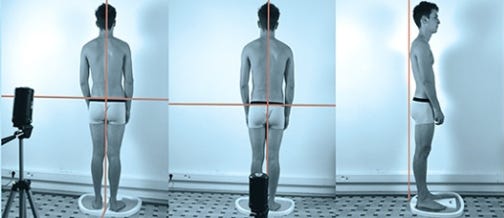
A weight suspended from a string—a plumb line—helps assess the alignment of the spine when viewed from the side, as shown in the third image on the right.
The platform must allow the body to be positioned centrally so that the laser projected onto the body can reliably identify whether a true asymmetry is present:
According to Vallier’s method, which is based on careful observation and clinical reasoning, there are eight possible patterns of body asymmetry in relation to the vertical axis, whether the body is viewed from behind or from the side. This is one example:
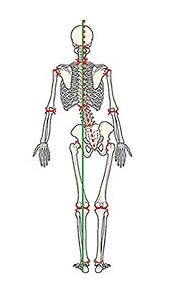
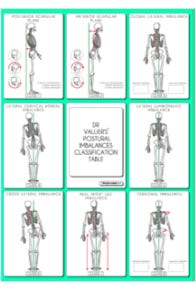
Depending on the pattern of imbalance observed, one may be more likely to suspect dysfunction at the level of the feet, mandible, or visual sensory system. Other findings may suggest an imbalance involving the thoracolumbar or cervicothoracic junctions, among other regions.
The pelvis may be rotated anteriorly or posteriorly, in addition to displaying various lateral deviations from the midline. Torsional patterns of imbalance may also be present.
The Bassini Foam Test
The person stands on a foam surface, which reduces the reliability of sensory input from the soles of the feet. It also diminishes cutaneous feedback and afferent proprioceptive information from the ankles.
This makes it possible to assess the contribution of the visual and stomatognathic systems while reducing the likelihood that plantar input is compensating for an underlying imbalance. In this way, the clinician can explore whether visual, vestibular, or stomatognathic sensory inputs may be contributing to the postural deficiency.
If the practitioner’s thumbs, placed bilaterally over the posterior superior iliac spines, become asymmetrical while the patient’s eyes are closed and their teeth are clenched, this may suggest that the imbalance originates in the stomatognathic system.
If the asymmetry is instead observed with the patient’s eyes open and mouth relaxed, it may suggest a visual contribution to the imbalance. In posturology, this approach may be used to assess whether prescribed prism correction produces a measurable change in postural alignment.
The test can also be performed with the patient seated on an examination table, with the legs hanging freely so that plantar input from the ground is removed. However, this interpretation requires the absence of significant sacroiliac joint restriction or dysfunction.
This test helps narrow down the potential source of the postural imbalance:
- Whether it is related solely to visual sensory input
- Whether it is related solely to mandibular or stomatognathic sensory input
- Whether both visual and mandibular sensory inputs contribute to the postural imbalance
Maddox Test
Determines whether visual alignment is normal or impaired.
This is primarily a screening test. If an abnormality is suspected, optometrists and ophthalmologists can perform a battery of specialized visual and postural assessments to determine whether the person may benefit from visual rehabilitation or whether prism correction could be indicated.
Podoscope
Highlights structural imbalances in the soles of the feet. This falls within the domain of podiatry, with postural podiatry representing a highly specialized niche.
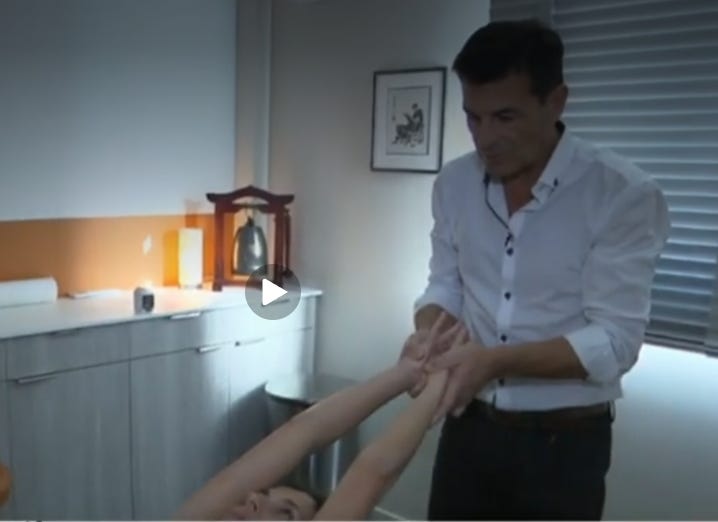
Scapular Test
This is equivalent to the Bassani Foam Test, which evaluates the alignment—or lack of alignment—of the practitioner’s hands when they are positioned over the patient’s posterior superior iliac spines. In this version, the test is considered normal when the patient’s hands are aligned:
Personal experience
The first Posturology specialist I consulted was an optometrist. She explained that some people with Ehlers–Danlos syndrome (EDS) may experience difficulties comparable, in certain respects, to those encountered by astronauts after prolonged exposure to microgravity: altered sensory integration, impaired balance, and a feeling of being physically “ungrounded.” She used this practical term to describe what she considered a global postural deficiency.
For me, this helped make sense of a type of clumsiness I jokingly describe as being mal-à-droite et pire-à-gauche—roughly translated, “bad on the right and worse on the left.” Research does support the presence of reduced proprioceptive precision and altered postural control in some people with EDS, especially where joint hypermobility is present.
Paradoxically, some people with EDS may feel more coordinated during deliberate movement or structured physical practice. Activities such as qigong, yoga, or martial arts may provide enhanced visual attention, muscular engagement, repetition, and external reference points. This is a personal observation rather than a general rule: EDS presentations and physical abilities vary widely between individuals. A hypermobile Judo Sensei can rule in the Tatami and be clumsy person outside of it.
Visual assessment and prisms
A posturology-trained optometrist may perform multiple assessments of posture, vision, binocular coordination, and visual alignment to explore whether prism correction could be helpful. In some cases, the aim is to determine whether visual rehabilitation alone is likely to be sufficient or whether a prism prescription should be considered.
The rationale proposed in some posturological approaches is that, when connective-tissue abnormalities affect the tissues surrounding the eyes and contribute to unstable oculomotor or sensory integration, conventional visual exercises may not fully address the underlying difficulty. Evidence does show that hypermobile EDS can be associated with altered somatosensory processing, reduced postural stability, and greater reliance on visual input; however, prism treatment should be prescribed and monitored by qualified eye-care professionals, and its benefits should be assessed individually.
My response to prisms
After undergoing this diagnostic process, I wore my prescribed prisms for the first time and experienced an immediate, marked reduction in anxiety. I felt more focused, more grounded, and less fatigued. That night, I also noticed unusually vivid dreams.
This was, of course, my individual experience and cannot establish that prisms treat attention-deficit symptoms, anxiety, or fatigue in general. Nevertheless, it made me reconsider how a seemingly small visual-alignment problem might influence concentration, sensory comfort, and everyday energy expenditure in a susceptible person.
To gain an idea of the prevalence of visual misalignment and related binocular-vision problems, it is useful to consider the following recent study:
Long-term ocular symptoms following COVID-19 linked to immune dysregulation, dysautonomia and peripheral neuropathy, Nature Communications (2026, doi:10.1038/s41467-026-74858-4)
“The high level of disability and characteristic symptoms may partially be explained by ocular misalignment, depleted fusional reserves, and reduced near vision and monocular acuity, all components of strabismus, leading to classic symptoms of headaches, eye fatigue, blurred vision, double vision, and ocular discomfort. When resolving small details, visual acuity is sensitive to suboptimal pupil size and in our data, a pupillary dysautonomia with weakened pupil constriction responses correlated with reported light sensitivity, headaches, reduced focusing ability, and reduced focus adjustment.”
As it happens, I addressed what appeared to be a congenital ocular misalignment during the COVID-19 pandemic. What surprised me most was the extensive diagnostic process used to determine whether I was an appropriate candidate for postural correction with prisms.
The underlying issue was a latent ocular misalignment—also called heterophoria or phoria. In this condition, the eyes have a natural tendency to deviate from parallel alignment, but binocular fusion keeps them aligned during ordinary visual tasks. A heterophoria is common and is not necessarily symptomatic; however, sustained effort to maintain fusion can be associated with symptoms such as eyestrain, headache, or difficulty during prolonged near work in some individuals. A careful differential assessment and a supervised prism trial are therefore important before prescribing prism correction.
In my own case, prism correction was associated with improvements in the cluster of symptoms described above, including anxiety, fatigue, eye strain, and episodes of double vision. This is a personal clinical experience rather than proof that prisms treat these symptoms universally; individual responses and indications for prisms vary considerably.
Proprioceptive insoles
Later, I was fitted with proprioceptive insoles by a podiatrist specializing in posturology. I noticed an increase in lower-leg muscle tone and, subjectively, a much stronger sense of my feet and legs contacting the ground. It felt as though I could perceive my lower limbs properly for the first time.
I came to feel that, in my own case, supplements, complementary therapies, and exercise could not fully substitute for carefully selected postural interventions when dealing with a broader postural-control difficulty.
Proprioceptive insoles are intended to influence postural control through tactile and proprioceptive stimulation of specific plantar areas. Small, strategically positioned contours can stimulate mechanoreceptors in the sole of the foot and may influence reflex motor responses.
My insoles included a corrective feature known as a retrocapital bar, positioned behind the metatarsal heads. I experienced an immediate increase in muscle tone throughout my lower legs. I was so surprised by the sensation that I exclaimed: “Oh my God, I can feel my legs!”
Measuring change
Posturologists may use objective tools to assess whether an intervention is associated with a measurable change, rather than relying solely on the patient’s subjective report. One such method is stabilometry, also called static posturography. It quantifies postural sway during quiet standing, usually by recording the movement of the centre of pressure on a force platform. It assesses postural equilibrium and balance by measuring the mechanical oscillations of the body’s center of gravity.
In my assessment, the Vertical Barré test showed a lateral deviation of my upper back and neck from the midline. This raised the possibility of contributions from visual, vestibular, and mandibular sensory inputs. After the sensory imbalances identified in my assessment were addressed, the lateral deviation improved.
Some tests are intended to help determine whether correcting a particular imbalance is likely to improve postural control.
For example, I have chronic subluxation of the temporomandibular joint, which produced positive findings on each of the tests described above. I consulted a dentist trained in posturology who performed a further assessment and concluded that correcting the subluxation was unlikely to improve my posture. This was consistent with my own impression.
In my case, this assessment helped me avoid pursuing an intervention—such as surgery or wearing a nocturnal occlusal splint—solely for the purpose of postural correction.
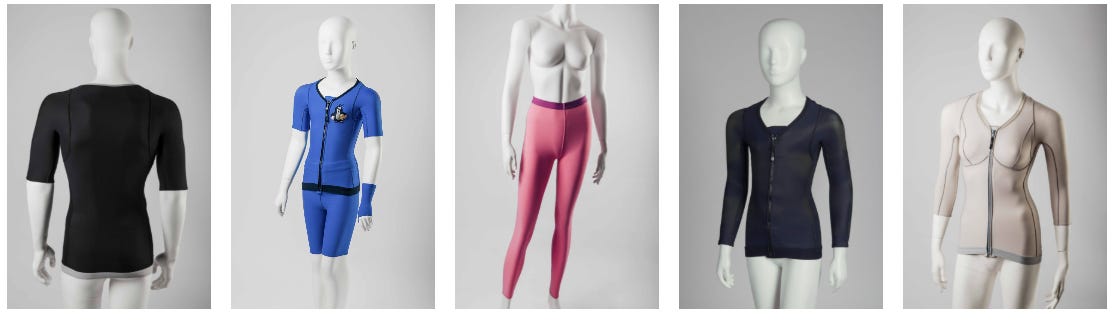
I addressed my organ and skin-sensor imbalances with compression garments, which serve as an adjunctive treatment for hypermobile Ehlers–Danlos syndrome (hEDS) and hypermobility spectrum disorders (HSD), significantly reducing pain and improving balance. Research indicates that 80% of patients experience clinical benefits, including reduced reliance on pain medication, improved joint stability, and enhanced proprioception, which may help compensate for sensory impairments.
In general, prescriptions for these garments provide compression of between 10 and 13.5 mmHg for a circumference of 24 cm, and between 6 and 10 mmHg for a circumference of 55 cm. This may increase cutaneous sensory feedback and provide mechanical support. In people with hEDS or HSD, it may help compensate for impaired proprioception, joint instability, or altered sensory processing associated with structural abnormalities of connective tissue.
In practical terms, compression garments markedly increase my own sense of proprioception and physical grounding. I call them my “magic-trick garments.” For me, they provide a stronger sense of bodily containment and contact with the environment—an experience that I had previously struggled to achieve through supplements, complementary therapies, or exercise alone.
Conclusion
After I’ve put in place all the posturological measures and worn compressive garments, I haven’t had the incapacitating neck pain that came twice a year, like clock-work, and which worsened with osteopathic maneuvers on the neck.
There are many places to learn from, and ways to learn about, posturology. I strongly encourage practitioners working in the fields mentioned above to undertake practical training in posturology, or to invite an experienced practitioner to their area to lead a workshop.
This knowledge may spare patients considerable pain and unnecessary interventions. For example, a knee replacement may not correct a postural imbalance if the underlying contributing factors have not been identified. Similarly, eyeglasses that improve visual acuity may nevertheless worsen posture or body pain if they do not adequately address binocular alignment or other visual factors—as happened in my own case.
The most effective way to learn this clinical practice is through repeated, hands-on use of its diagnostic tools. No AI can do this for you. For individuals seeking to benefit from this field, I encourage you find a skilled and thoughtful posturologist.
Further reading
Vallier’s method website in English.
Traité de Posturologie Clinique et Thérapeutique, Docteur Gérard Vallier (2016)
Traité de Posturologie de l’Enfant et l’Adolescent, Docteur Gérard Vallier (2018)
Méthode Docteur Gérard Vallier (2022)
La Reprogrammation Posturale Globale, Bernard Bricot (2020)
ShareSEP
About the Author:
A countryside family medicine doctor and former heart surgeon in service of the Hippocratic Oath.