


GLP-1 stands for glucagon-like peptide-1. Drugs that activate its receptor are called GLP-1 receptor agonists (GLP-1RAs). Medications targeting this pathway are approved for indications including type 2 diabetes and obesity. In the United States, tirzepatide, marketed as Zepbound, is also approved for moderate-to-severe obstructive sleep apnea in adults with obesity. Tirzepatide acts on both GIP and GLP-1 receptors.
Diabetes, obesity and chronic obstructive sleep apnea are considered to be chronic inflammatory diseases. There is also growing interest in whether these medications could help with other inflammatory conditions beyond their approved indications.
One proposed application is mast cell activation syndrome (MCAS). The rationale includes the presence of GLP-1 receptors on mast cells and the possibility of modulating their activity. Experience reported to date appears to have been distinctly positive.
For background on mast cell dysregulation and the possible connections discussed in relation to Long COVID and other complex chronic conditions, see my earlier article:
What’s wrong with my immune system? When connective tissue inflammation ‘explains the unexplainable’
Semaglutide and tirzepatide—perhaps best known under the brand names Ozempic and Mounjaro, respectively—are among the medications discussed here. You may have heard concerning reports about their adverse effects, specially when used at standard or high doses as a substitute for a healthy lifestyle that includes consuming protein from animal sources and exercising regularly. As with everything, there is good and evil, and the specific circumstances determining which is which.
What prompted me to investigate low-dose use was a series of 47 patients with MCAS treated with GLP-1 receptor agonists. Clinical benefit was reported in 89% of patients. Published in the October 2025 issue of The American Journal of the Medical Sciences, the report offers an encouraging signal in a difficult-to-treat population. In short, the treatment produced miraculous results in patients who were otherwise receiving palliative measures.
Utility of glucagon-like-peptide-1-receptor agonists in mast cell activation syndrome
Let’s look at one of these 47 cases as an illustration:
Illustrative case 1 (online supplementary Table 1, case 1)
A young man of weight near the upper limit of normal for his height presented at age 18 with chronic multisystem inflammation since early infancy, dominantly frequent upper respiratory tract infection-like episodes, diffusely migratory tendinitis and spondyloarthropathy, painful diffuse cutaneous hypersensitivity, cold urticaria, and frequent flushing and diaphoresis. At puberty, migratory abdominal pain, non-bloody diarrhea, diffusely migratory pruritus, severe cystic acne, anxiety, panic, depression, and temperature dysregulation became dominant issues; urticaria worsened to also be triggered by heat, and he developed labile hypertension. When the patient was 15, his pediatrician suspected MCAS and empirically started him on cetirizine, yielding improvements in GI and connective tissue issues, which still worsened seasonally. Symptoms also worsened when he matriculated into college and was housed in an overtly moldy dormitory. Montelukast and ketotifen were empirically started, with some additional improvements. At 18, he pursued evaluation for MCAS, finding elevated plasma heparin and an increased MC count in a duodenal biopsy. Trials of many medications ensued, failing non-steroidal anti-inflammatory drugs (NSAIDs), cromolyn, cannabinoids, quercetin, and omalizumab (as well as many “natural supplements” started by other providers he consulted) but finding some benefits from H1 and H2 receptor antagonists and glycopyrrolate, plus occasional benzodiazepines. Chronic fatigue, cognitive dysfunction (“brain fog”), and ravenous nocturnal hunger became dominant issues after he graduated and started working in a white-collar position. At 24 (one year ago), semaglutide (tried for his MCAS, accessed off-label) was started with weekly subcutaneous 0.25 mg dosing. Within hours his hunger and blood pressure had normalized, and his fatigue, brain fog, and all of his inflammatory issues were substantially reduced. Dosing was increased in 0.25 mg steps over the next few months, finding enough improvement with each increase (another provider found remarkable improvement in mitochondrial function testing, too) that he settled at 0.75 mg, but recently a pharmacy error increased dosing to 2.0 mg, bringing noticeable further improvement in symptoms. No adverse effects have been observed at any dose level, and he has lost 30 pounds, still well within normal range for his height but with clarity on serial physical examinations that most or all of this weight loss was reduction in longstanding inflammatory edema rather than adipose tissue.
And here is a case involving a woman with a hypermobility spectrum disorder who also suffered from POTS (postural orthostatic tachycardia syndrome):
Illustrative case 3: a woman with MCAS, POTS, and features of a hypermobility spectrum disorder
A 50-year-old obese woman presented with a six year history of dysautonomia, unexplained dyspnea at rest, orthostatic dizziness, fatigue, acid reflux, nausea, and headache of post-viral onset. She also reported significant difficulty concentrating and trouble working (“brain fog”). Based on a 10-minute stand test, she was diagnosed with POTS, and her Beighton score was 7/9, compatible with a hypermobility spectrum disorder. She was also diagnosed with MCAS based on clinical features and elevated serum histamine level. She was started on famotidine and loratadine, which partly improved her symptoms. Increased fluids and salt intake and gluten-free diet were also initiated, and she reported improved postural tachycardia and headache frequency. Subsequently, she was started for weight gain on tirzepatide 2.5 mg subcutaneously weekly, soon increased to 5 mg weekly, resulting in her reporting at least 65–70 % improvement in her symptoms, including fatigue and cognitive impairment. She felt she was being productive for the first time in years. She tried discontinuing famotidine and loratadine, but MCAS symptoms worsened, so she restarted them. She has experienced no adverse effects from tirzepatide, and she has lost 76 pounds (37 % from her baseline weight) in her two years thus far taking it.
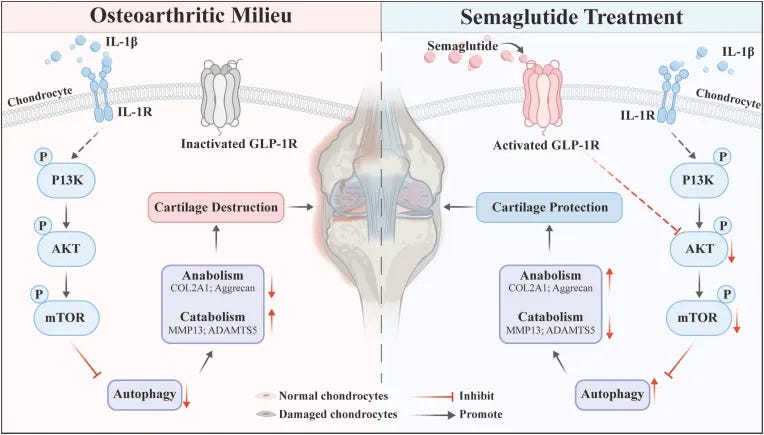
Improvement may stem not only from the regulation of mast cells but also from other effects. Semaglutide may have a chondroprotective effect independent of its effects on weight loss, with reductions in cartilage degeneration, synovial lesions, and pain sensitivity in animal models (DOI: 10.1016/j.cmet.2026.01.008). A reduction in pain has also been observed in a human clinical trial (N Engl J Med 2024;391:1573–1583; DOI: 10.1056/NEJMoa2403664).
The low-dose approach described involves using an initial dose equivalent to 25% of the lowest approved dose for treating type 2 diabetes or obesity, with reportedly very good tolerability. As described in the study, people still needed their anti-histamine medications to ameliorate tolerability when introducing any drug, as is usually the case in people with MCAS.
On a personal note, although this approach is not included in official recommendations, I decided to try it in August, starting at a dose equivalent to 25% of the lowest approved dose. For me, this was a last resort before making a formal request for treatment at a specialized center.
And lo and behold, I am no longer considering going to a specialized center. I have more energy in my day-to-day life and can eat a wider variety of foods. For me, that already feels like something of a miracle.
I have not experienced any nausea. I noticed a slight slowing of bowel transit initially, but it remained manageable. At present, I am not constipated; on the contrary, this is the first time my bowel movements have been regular without my having to double my magnesium supplement doses or take laxatives. I have not lost any weight, and I am able to engage in more physical activity adapted to my abilities.
This is not an official recommendation, but rather a report from colleagues who are calling for clinical trials. It also partly explains why so many people are using these drugs off-label at low-dose. At the very least, I believe this study is worth reading to understand these patients’ “palliative” clinical circumstances, the limitations of their previous care, and the improvements reported with low-dose GLP-1 receptor agonists. These improvements were rather miraculous, considering the therapeutic dead-ends these patients had faced.
Note that, as with every agonist, it is advisable to reset the receptors to decrease dependency on increasing doses to see a positive effect. That is, taking a one-month break every three months and/or taking only two doses during the reset month avoids habituation. Some people, including me, also experience the same benefits when microdosing every 10 days instead of once a week.
And remember: this is not an official recommendation, but rather a compassionate consideration in palliative cases—also known as “Rescue Remedies for the Hopeless.”
ShareNOV
About the Author:
A countryside family medicine doctor and former heart surgeon in service of the Hippocratic Oath.